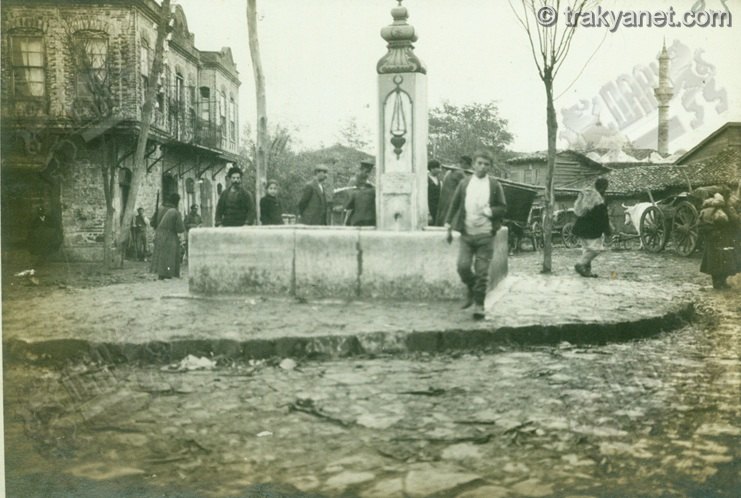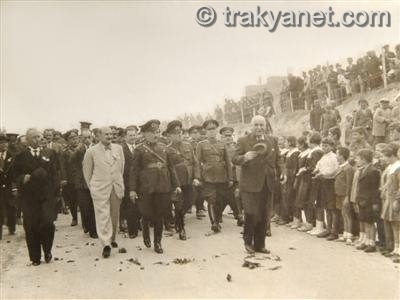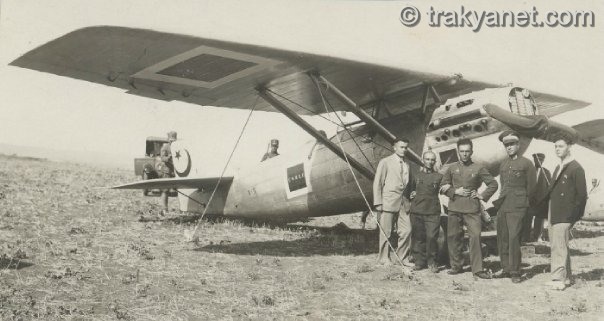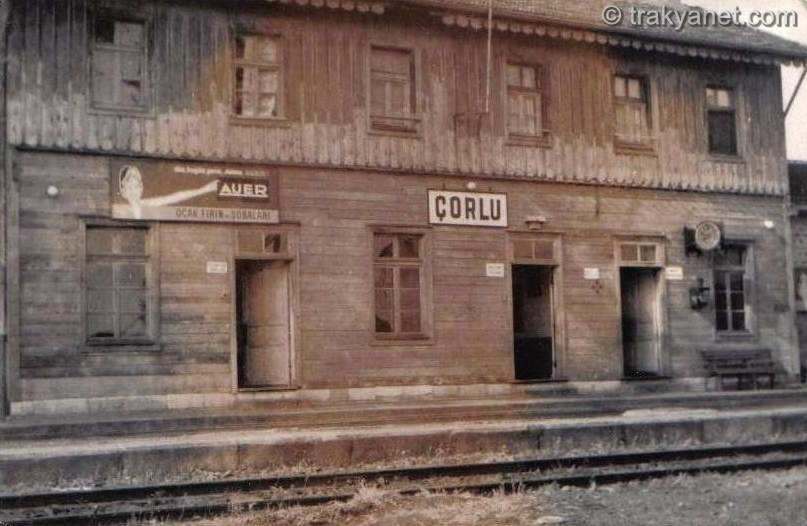

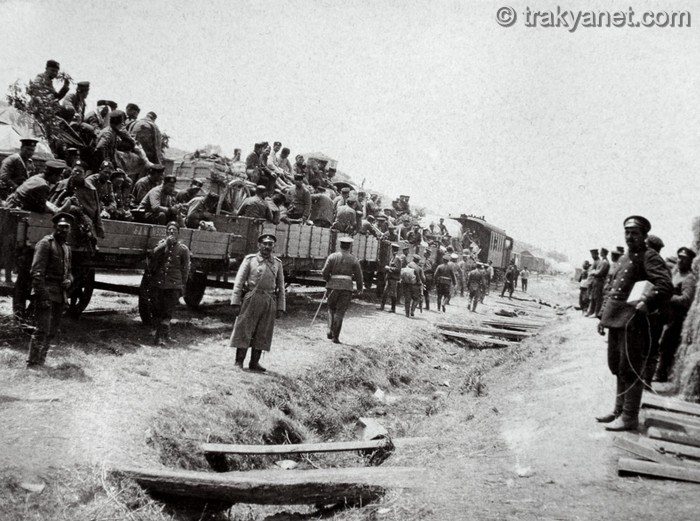
During the first phase of the 1912-1913 Balkan Wars, the headquarters of the Ottoman Eastern Army Command was located in Corlu. When news reached Corlu that the Bulgarians had captured Edirne and were advancing towards Babaeski and Luleburgaz during the Second Balkan War, the population panicked. To escape Bulgarian oppression, the people of Edirne province were abandoning their homes and trying to flee to Istanbul. These groups of people, fleeing to Istanbul by road, passed through Corlu, frightening the local population. Fearing a similar fate soon, they began packing their belongings.
When news spread that the Bulgarian army had approached the village of Marmaracik near Corlu, all the Turkish inhabitants of Corlu abandoned their homes in a single day. Those with cars used them, while those without walked. The people of Corlu reached Silivri, from where they boarded ferries and arrived in Uskudar. After nine months of longing for their homeland, the people of Thrace returned after the part of Edirne province up to the Meric River was recaptured during the Second Balkan War. Sadly, they found nothing but broken pieces of roof tiles where their houses had once been.
In Corlu, the Turkish neighborhoods were completely destroyed, reduced to ruins. It was the local Armenians and Greeks who looted and then burned these houses. When the Bulgarians withdrew, they remained in Corlu. They lived comfortably as if nothing had happened. The people of Corlu who returned to their cities joined hands with them without complaint and tried to restore Corlu to its former state.
Before the effects of the Balkan Wars had even subsided, World War I broke out. With the Ottoman Empire's entry into the war, those capable of bearing arms rushed to the front, and the long war lasted four years. In the end, we were defeated along with our allies.
The Armistice of Mudros was signed on October 30, 1918. The enemies had begun to occupy our country. At the Paris Conference, with the support of Great Britain, they obtained the right to seize Western Anatolia and Thrace.
After the Allied occupation of Istanbul, rumors began circulating that Thrace would also be occupied by the Greeks. It was clear that the Greeks would attempt to occupy Thrace, just as they had done in the Aegean region. This situation caused great excitement among the Turkish population of Thrace. Meetings were held in the towns, and organizations were being formed. Cafer Tayyar Pasha was at the head of the Thracian organization.
Since our soldiers had been demobilized at the end of the general war, there were very few soldiers left. The majority of them had been sent to the Greek border along the Maritsa River.
On the morning of Tuesday, July 20, 1920, the Greeks landed at Eregli on the coast of the Sea of Marmara, beginning their occupation of Thrace. Simultaneously, they also landed at Tekirdag, launching their invasion of Thrace from two directions. This news had a devastating impact on Corlu; the people of Corlu were bewildered, and some shopkeepers opened their shops, awaiting the outcome. That same day, Greek soldiers under the command of General Zimbrakis entered the city and arrived in front of the municipality building. A large group of Greeks, led by a priest, took over the building. The Turkish flag was lowered and replaced with the Greek flag.
On the morning of July 21, Greek forces in Corlu continued their march towards Karistiran. In the days before the Greek occupation, the Thrace Pasaeli Defense of Rights Association had been established in Thrace and had begun its work. Partial mobilization had been declared, and the commander of the First Corps, Colonel Cafer Tayyar Bey, had been appointed to head this organization.
Twenty days after the occupation of Corlu, on August 30, 1920, the Treaty of Sèvres, which meant a death sentence for the Turks, was signed. After the signing of the treaty, the Greeks handed over military administration to civilian administration in Corlu. The handover of Corlu to civilian administration on August 15, 1920, is mentioned as a memory in Muhiddin Tuna's work "From the Past to the Present" as follows:
A flurry of activity had begun in Corlu in the early hours of the morning. Around nine o'clock, soldiers with bayonets fixed to their weapons were lined up opposite each other at intervals of twenty meters along the street from the Greek Orthodox church (where the Gazi School was located) to the government building (where the current municipal business center is). At ten o'clock, a ceremony was held in the church. This ceremony was attended by local Greeks, Armenian leaders, and a very small number of Turks, primarily priests. The Turks who were present had been forcibly taken away. Among them was the Mufti of Corlu. After the ceremony, they left the church. Local Greeks and Armenians joined them, and the large procession passed through the soldiers to the Government Building.
A new district governor was to be appointed to Corlu today. This governor was Ispiridis, a lawyer and the son-in-law of Trosolos, originally from Corlu. He was a young lawyer. The flagpole, which had flown the Turkish flag for years, was prepared for the ceremony and flag-raising. Golcuk Square was filled with Greeks, Armenians, and other minorities. Everyone was waiting for the ceremony to begin. Finally, around noon, the ceremony started.
Lawyer Ispiridis gave a short speech in Greek. Following this, the flag-raising ceremony at the Government House began. The Despot was praying, and the flag was slowly being raised up the pole. Before it reached the top, the pole swayed. It broke at the base and fell. The Greek flag fell to the ground. Some considered this an ill omen. The pole, which had carried the Turkish flag for many years at the building that had served as the government building in Corlu, did not want to carry the Greek flag today. Immediately, several people picked up the Greek flag from the ground. This time, they waited for a new pole to arrive. A pole hastily made by a carpenter arrived. Thus, the flag-raising was delayed by an hour. The breaking of the pole had dampened spirits, and the excitement in the ceremony had disappeared. Around 1 PM, the ceremony ended. Everyone dispersed, and the administration was now handed over to civilians.
Lawyer Ispurudus became the district governor, and Karapapaida became the mayor. Until then, Istanbul newspapers were delivered to Corlu, and we read them. After that day, Istanbul newspapers were no longer allowed into Corlu.
The victory in the Battle of Sakarya in August 1921 caused anxiety among the Greeks. Young Greek men of military age in Corlu were conscripted. The start of the Great Offensive on the morning of August 26, 1922, and the subsequent defeat of the Greek Army within four days, led to Turkish cavalry entering Izmir on September 9th. Meanwhile, thanks to Turkish units advancing north towards Eskisehir and Bursa, the Christian population had disembarked in Eregli and Tekirdag by ships and boats.
Those who had landed in Eregli had reached Corlu. They were fleeing to Greece via Corlu. During this escape, the city was looted. On the other hand, the town's leading figures were rounded up one by one and taken to the gendarmerie station. These people were then transported by train to Dedeagac, and from there, along with others gathered in other parts of Thrace, they were sent to the island of Milos. A week after our citizens were taken to the island of Milos, on October 3, 1922, armistice negotiations began in Mudanya. The Armistice Agreement was signed on October 11, 1922. According to the armistice, armed clashes would cease starting from the night of October 14-15. The Greeks would immediately evacuate Eastern Thrace and hand it over to the administration of the Grand National Assembly government. Allied troops would take over Thrace from the Greeks and would act as a buffer between the Turkish Army and the Greeks.
To take Thrace from the Greeks, the Italians were to operate in Silivri, Vize, Saray, and Corlu; the French in Edirne, Luleburgaz, and Kirklareli; and the British in Uzunkopru, Tekirdag, and Kesan. When Italian troops arrived in Corlu on October 15, 1922, they were met with a scene of devastation and destruction. The following day, the administration in Corlu was taken from the Greeks, and a provisional Turkish government was established. Abidin Efendi was appointed governor, and in accordance with the Mudanya Armistice Agreement, the Italians remained in Corlu until November 1, 1922. On November 1, 1922, a Turkish delegation and soldiers arrived by train from Istanbul and took over the city.
Corlu continues to be an important garrison in terms of defense, a feature it has maintained since World War II.
Source Articles:Ottoman History Encyclopedias,
Republic of Turkey Revolution History and Ataturkism - Prof. Dr. A. Mumcu,
Corlu from Past to Present - Muhiddin Tuna